
Your account
News
Plug-in solar: why Alderney needs to wait
12 August 2026 | News
From 27 August, new UK rules will allow approved "plug-in solar" systems, also known as "balcony solar", to be bought and connected to household electricity supplies.
The attraction is obvious. A couple of solar panels and a small inverter can allow households to generate some of their own electricity cheaply and simply.
Alderney Electricity supports the technology in principle. We want more renewable energy and we want islanders to pay less for electricity.
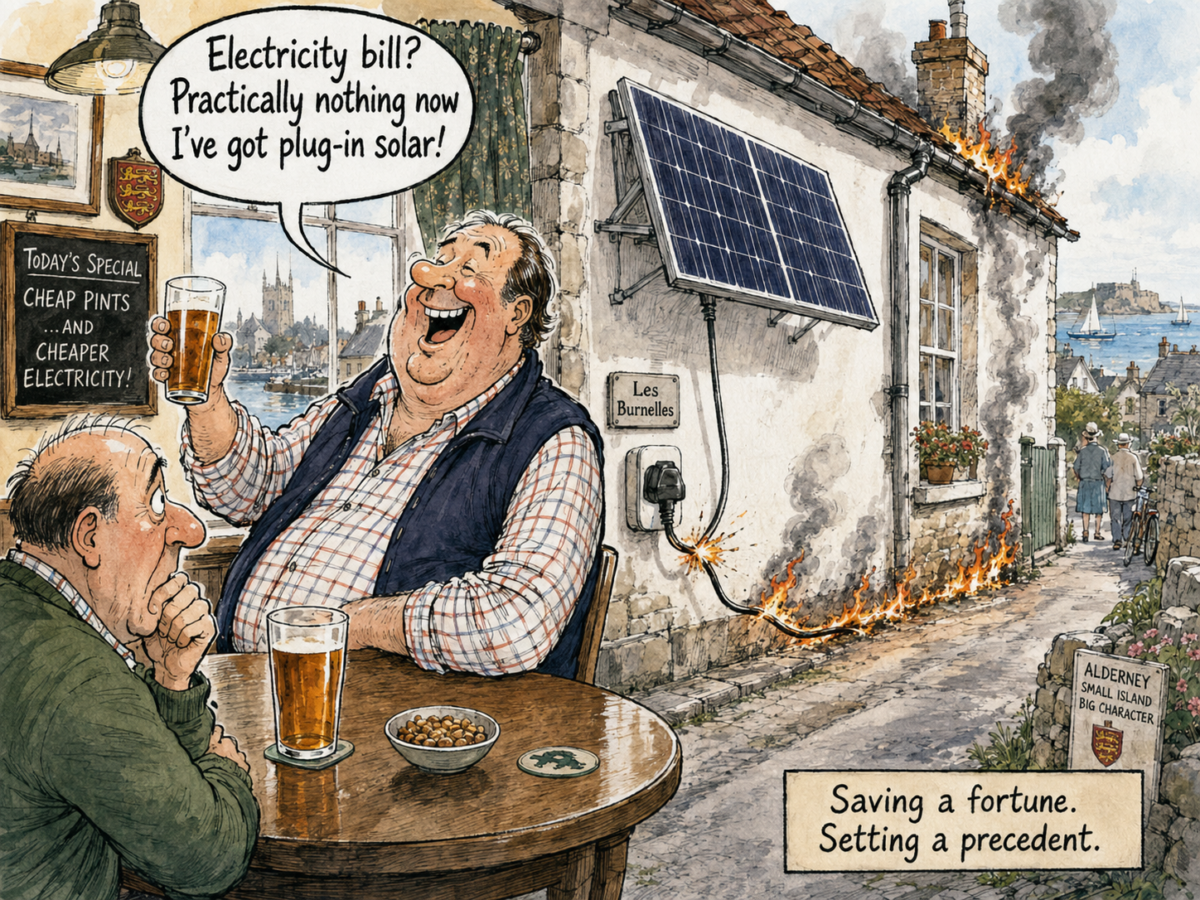
But what becomes permissible in the UK does not automatically become permissible in Alderney. Plug-in solar is not currently approved for connection to our electricity system.
There are three main reasons:
1. Our grid is different
Alderney operates a tiny, isolated electricity system with no interconnector. Generation and demand must be balanced on-island every second of every day.
Our network was also designed principally for electricity to flow in one direction, from the power station to customers. Distributed solar changes that.
We already have 21 rooftop solar installations, which give us useful data on how our small network behaves. We are commissioning a detailed network stability and renewable integration study to establish how much additional solar different parts of Alderney can safely accommodate, and what improvements to monitoring, protection, control or storage will be required.
Until we understand that properly, allowing an unknown number of generators to be plugged in around the island would be irresponsible.
2. It must be safe in the home
Most properties on Alderney provide their own earth connection through a rod at the property, rather than taking an earth from our network. That puts more of the safety burden on the protective devices inside the house, particularly the RCD.
Our housing stock and wiring also vary considerably in age and electrical condition. A plug-in solar system is a generator, not simply another appliance. Connecting one changes how electricity can flow through a household circuit.
The issue is not that plug-in solar is inherently unsafe. It is that AEL cannot presently establish that an uninspected customer's wiring, their protective devices and their chosen plug-in generator will work correctly together, particularly when something goes wrong and a circuit is being fed from both ends at once.
We need to know that all three are a safe combination before we can approve it.
3. We need the rules first
The UK has not simply decided that any solar panel can be plugged into any socket. The change comes from the Plugs and Sockets etc. (Safety) (Amendment) Regulations 2026, and it is tightly drawn. Output is capped at 800VA and 3.5A. Only complete, certified products meeting the official specification qualify, not self-assembled kits. The panels must plug into a socket using the cable supplied, with no extension leads or adapters. Battery storage is excluded at this stage.
Just as importantly, the UK framework relies on institutions that Alderney is not part of. No product can be sold until it appears on the Energy Networks Association (ENA) type test register, and connections are notified to the local network operator under Engineering Recommendation G98, which is being revised specifically to deal with these devices.
Alderney is not an ENA member and has no G98 process. There is no register an islander could check a product against here, and no notification route. We need our own framework covering approved equipment, notification, electrical checks, metering and permission to connect. That work has not been completed yet.
What this means for customers
This does not mean AEL is against solar. Quite the opposite. We have customers waiting to install conventional rooftop solar and we will work with them as our understanding of network capacity develops. All installations must, however, go through AEL's approval and commissioning process.
Our message is simple: please do not buy a plug-in solar system online and ship it to Alderney expecting to connect it. It is not approved for use here.
If you have already bought one, or have already connected one, please contact us. We would far rather hear from you than find out later. There is no penalty for coming forward and we will talk you through where things stand.
Connecting generation to our network without permission is not a new rule we have invented this month. It is dealt with under the Alderney Electricity Law 1953 and our conditions of supply. Where unauthorised generation is found and cannot be made safe, we may have to disconnect a property to protect the occupants, the property and the wider network. We would much prefer never to do that.
What happens next
The network stability and renewable integration study is being commissioned now, and we will publish its findings and what they mean for new connections. If you are considering solar of any kind, please talk to us first at electrical@alderney-elec.com
Plug-in solar may well have a future here. Before it does, we need to show that our grid can accommodate it, that our homes can use it safely, and that the right safeguards are in place to keep the island safe and the supply reliable.
Latest information
News, updates and blog
Read the latest service notices, maintenance updates and news from across Alderney Electricity.